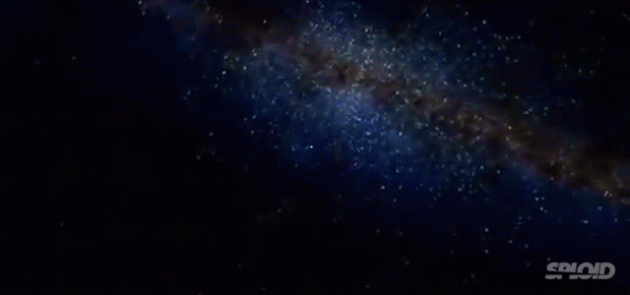
We're going to be able to see a star go supernova in the Milky Way in the next 50 years. How often is that? Lets hope you get to live that long.
This study suggests that they have a solid chance of doing something that's never been done before: detect a supernova fast enough to witness what happens at the very beginning of a star's demise. A massive star "goes supernova" at the moment when it's used up all its nuclear fuel and its core collapses, just before it explodes violently and throws off most of its mass into space.
According to one of the researchers, doctoral student Scott Adams, "every few days, we have the chance to observe supernovae happening
outside of our galaxy. But there's only so much you can learn from
those, whereas a galactic supernova would show us so much more. Our
neutrino detectors and gravitational wave detectors are only sensitive
enough to take measurements inside our galaxy, where we believe that a
supernova happens only once or twice a century."
[
EurekAlert]