If smartwatches aren't big yet, it's because Google hasn't released their cancer-killing smartwatch. The company recently unveiled a technology that would send 'tiny magnetic particles into patients' bloodstreams,' which are activated via a smart wristband, and would then seek out and destroy cancer cells.
This is a whole lot better than being able to check Facebook notifications on your wrist.

Last year, Google announced a new addition to their secret research division called Google X. The new department is known as the Life Sciences Team, and they were tasked with changing the face of medicine.
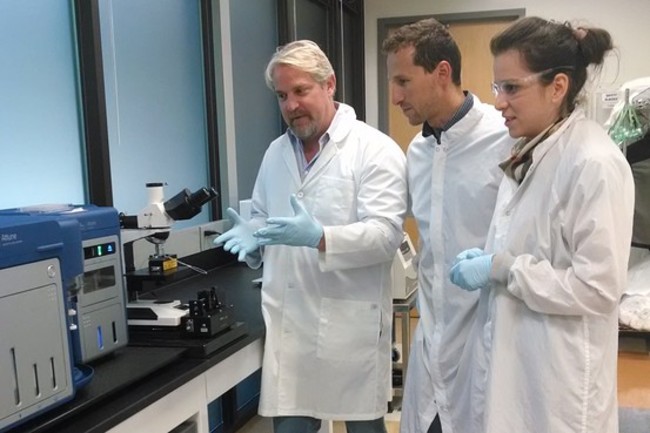
This is Andrew Conrad, head of Google X's Life Sciences Team with colleagues Alberto Vitari and Marija Pavloic.
The Life Sciences Team announced that it was designing tiny magnetic particles to patrol the human body for signs of cancer and other diseases.
This is how it would work: patients would absorb the tiny magnetic particles into their blood stream by either injection, ingestion or inhalation. Then they would snap on the "watch" in a location close to a major artery or vein where it would transmit energy similar to a radio frequency pulse, causing the magnetic particles to 'vibrate and heat up.' Finally, it would then attack and eliminate the pathogen.
The technology is at least 5 years out, but if this works, it could change the face of medicine forever.