





















































Just What Makes This 12-Year-Old Girl The 'Next Steve Jobs'?
Oct 25, 2013 20:09
When you think of "genius" today, you'll probably picture some white guy with
glasses who works in Silicon Valley. But thanks to experimental teaching methods, even a young girl from a dirt-poor town of Mexico has a chance to be a future
game-changing icon.
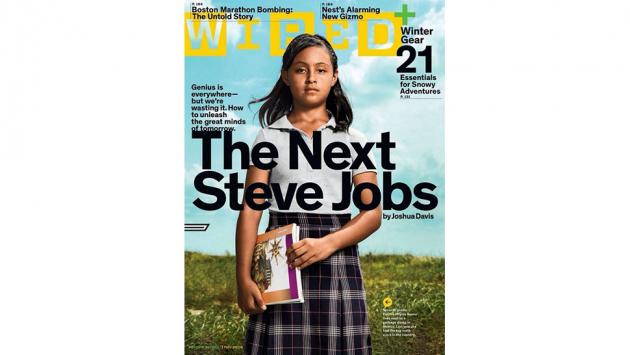
Meet Paloma Noyola Bueno, a 12-year-old student from the José Urbina López Primary School in Matamoros, Mexico. As you can see in this headline, Paloma is being touted as "the next Steve Jobs". The choice of words in the headline is purposely attention-grabbing, but the real story in the feature is about Paloma's teacher, Sergio Juárez Correa.
Frustrated with a boring curriculum and uninspired students, Juárez Correa decided to change his teaching methods after discovering videos about Sugata Mitra, a professor of educational technology at Newcastle University in the UK.
Mitra's work which emphasizes curiosity-fueled exploration instead of the usual discipline and routine schools generally enforce. It's all about giving kids to tap into their own innate ability by using critical thinking, free-thinking, and organic thinking.
When you think about it, this actually makes perfect sense. How can we expect kids to do their best when educational systems still insist on putting them in a rigorous box that involves forcing them to memorize instead of conceptualize?
So back to Paloma, who so happens to be one of these kids who can just figure stuff out on her own. And it was this brilliance that spurned her teacher to push for better teaching methods:
[Wired, Think Mexican]
Meet Paloma Noyola Bueno, a 12-year-old student from the José Urbina López Primary School in Matamoros, Mexico. As you can see in this headline, Paloma is being touted as "the next Steve Jobs". The choice of words in the headline is purposely attention-grabbing, but the real story in the feature is about Paloma's teacher, Sergio Juárez Correa.
Frustrated with a boring curriculum and uninspired students, Juárez Correa decided to change his teaching methods after discovering videos about Sugata Mitra, a professor of educational technology at Newcastle University in the UK.
Mitra's work which emphasizes curiosity-fueled exploration instead of the usual discipline and routine schools generally enforce. It's all about giving kids to tap into their own innate ability by using critical thinking, free-thinking, and organic thinking.
When you think about it, this actually makes perfect sense. How can we expect kids to do their best when educational systems still insist on putting them in a rigorous box that involves forcing them to memorize instead of conceptualize?
So back to Paloma, who so happens to be one of these kids who can just figure stuff out on her own. And it was this brilliance that spurned her teacher to push for better teaching methods:
Juárez Correa was impressed [by his class's response to experimental methods]. But he was even more intrigued by Paloma. During these experiments, he noticed that she almost always came up with the answer immediately. Sometimes she explained things to her tablemates, other times she kept the answer to herself. Nobody had told him that she had an unusual gift. Yet even when he gave the class difficult questions, she quickly jotted down the answers. To test her limits, he challenged the class with a problem he was sure would stump her. He told the story of Carl Friedrich Gauss, the famous German mathematician, who was born in 1777.
When Gauss was a schoolboy, one of his teachers asked the class to add up every number between 1 and 100. It was supposed to take an hour, but Gauss had the answer almost instantly.
“Does anyone know how he did this?” Juárez Correa asked.
A few students started trying to add up the numbers and soon realized it would take a long time. Paloma, working with her group, carefully wrote out a few sequences and looked at them for a moment. Then she raised her hand.
“The answer is 5,050,” she said. “There are 50 pairs of 101.”
Juárez Correa felt a chill. He’d never encountered a student with so much innate ability. He squatted next to her and asked why she hadn’t expressed much interest in math in the past, since she was clearly good at it.
“Because no one made it this interesting,” she said.
For all we know, there could be plenty of other Palomas in schools all around the world. But unless teachers start realizing that the old ways of teaching just aren't cutting it for today's kids, all that talent is going to go to waste.When Gauss was a schoolboy, one of his teachers asked the class to add up every number between 1 and 100. It was supposed to take an hour, but Gauss had the answer almost instantly.
“Does anyone know how he did this?” Juárez Correa asked.
A few students started trying to add up the numbers and soon realized it would take a long time. Paloma, working with her group, carefully wrote out a few sequences and looked at them for a moment. Then she raised her hand.
“The answer is 5,050,” she said. “There are 50 pairs of 101.”
Juárez Correa felt a chill. He’d never encountered a student with so much innate ability. He squatted next to her and asked why she hadn’t expressed much interest in math in the past, since she was clearly good at it.
“Because no one made it this interesting,” she said.
[Wired, Think Mexican]