




















































OLEDs of the Future Could Soon Be Inkjet Printed
Nov 22, 2013 20:54
In the future, we'd probably expect all our displays to be OLED: it's thin, light, deep with color, and it's energy efficient. But it's also incredibly expensive.
All that could soon change, thanks to a jumped-up inkjet printer.
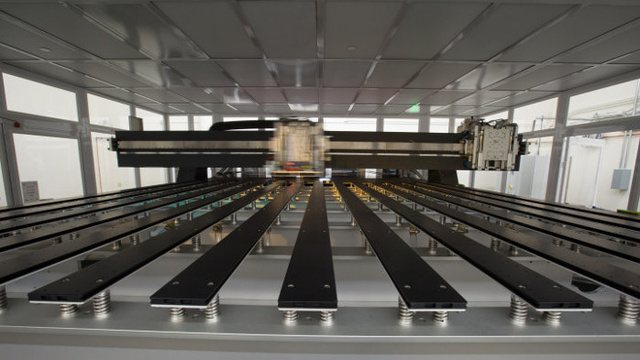
A new technique has been developed by a company called Kateeya, and is now being made available to display makers. A moveable platform precisely positions glass or plastic panels beneath printheads, each of which contains hundreds of nozzles. Each nozzle deposits picoliter droplets in exact locations to build up the pixels of a display.
OLEDs are usually made in a vacuum chamber where thin films of organic materials are deposited by condensing vapors onto the panel, using fine metal stencil to make sure it ends up in the right place. That technique, however, is often wasteful - the vapors condense onto the entire surface, stencil and all, so it uses more material. Plus the act of removing the stencil can easily damage the displays too, so a lot are written off - which hikes up prices.
The inkjet method solves both issues, although until now it's been far from a commercial possibility because the deposited materials aged badly. But MIT nanotechnologist Vladimir Bulović explains, "the latest material sets are actually extremely stable" when printed.
The only possible downside to the process is that it's "dirty," at least in the sense that no mask is used, so it's possible for material to fall where it's not wanted. Kateeva says that careful design mitigates this potential problem; in fact, it says it's reduced particle contamination by as much as 10 times compared to conventional processes.
So this would suggest that apart from printing your documents, ink jets could soon be used to print your TV!
[Technology Review]
Image via Kateeva