





















































Scientists Are Going to Try to Cure Alzheimer's With Lasers
Nov 05, 2013 22:50
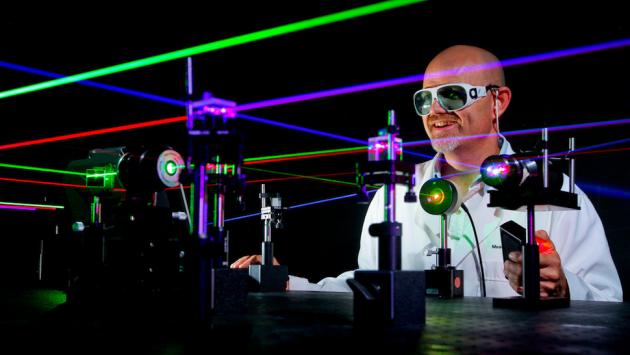
Medical researchers have been looking for a cure for Alzheimer's disease for decades already. They may have just made strides by discovering they may be able to zap away the bad proteins that cause diseases like Alzheimer's, Parkinson's and Creutzfeldt-Jakob (a.k.a. mad cow) disease—with lasers.
That's right. Just lasers. A team of researchers developed a multi-photon laser technique that can distinguish between healthy proteins and toxic amyloids. Healthy proteins are "optically invisible" to the high powered lasers so they are less likely to be zapped away.
"Nobody has talked about using only light to treat these diseases until now," said Piotr Hanczyc at Chalmers University of Technology in Sweden. "We have found a totally new way of discovering these structures using just laser light."
This new method would actually eradicate the disease altogether, rather than simply treat it.
[Chalmers Univ. Image via Flickr / U.S. Navy]