


















































The Red Dots You See Here is Where Plant Life Is Thriving
Mar 11, 2014 18:49
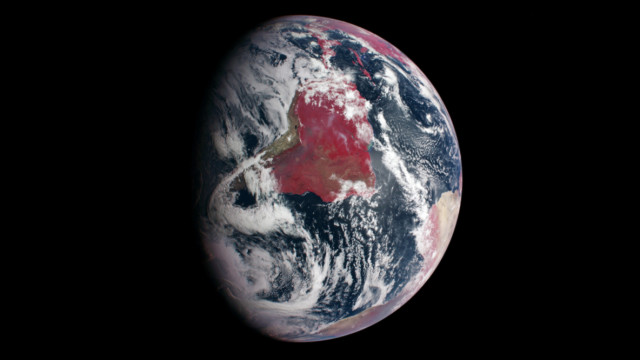
You're checking out a false color image showing plant growth across a planet in red where you'd usually expect some green. The image, captured by NASA's Mercury Surface, Space Environment, Geochemistry and Ranging (MESSENGER) spacecraft is explained below:
The wide-angle camera records light at eleven different wavelengths, including visible and infrared light. Combining blue, red, and green light results in a true-color image from the observations. The image substitutes infrared light for blue light in the three-band combination. The resulting image is crisper than the natural color version because our atmosphere scatters blue light. Infrared light, however, passes through the atmosphere with relatively little scattering and allows a clearer view. That wavelength substitution makes plants appear red. Why? Plants reflect near-infrared light more strongly than either red or green, and in this band combination, near-infrared is assigned to look red.
Healthier plants reflect more near infrared light than stressed plants, so that means NASA can keep track of how things are growing, and not just where. Will this make it easier for us to find life elsewhere around the universe? [NASA]